
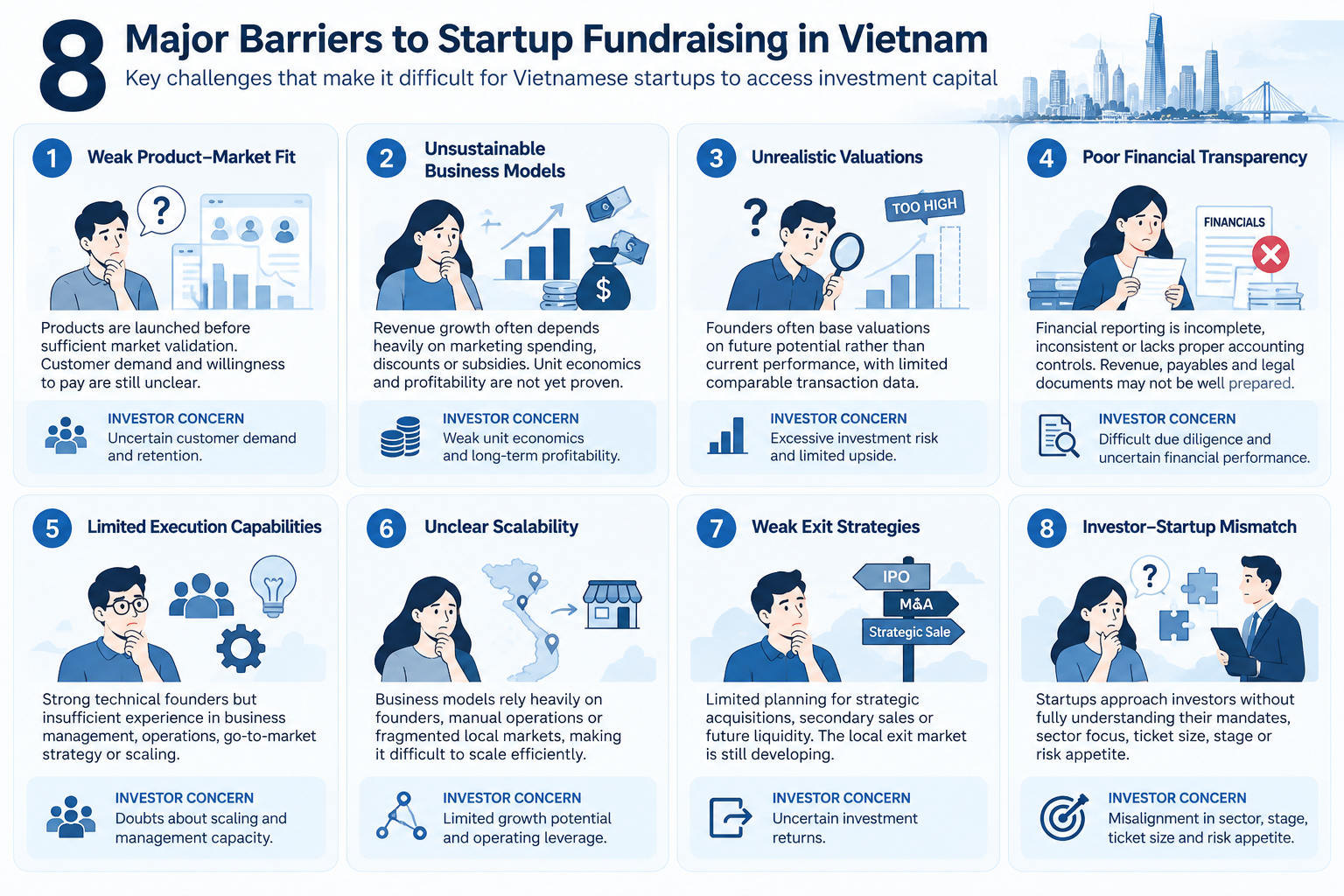
Vietnam has emerged as one of Southeast Asia's promising startup ecosystems, supported by a growing digital economy, entrepreneurial talent, and increasing demand for technology-driven solutions.
However, access to investment capital remains a significant challenge for many Vietnamese startups, even those with innovative products, promising markets, and early commercial traction.
The fundamental issue is not simply a shortage of capital. It is often a mismatch between startup investment readiness, investor expectations, and the availability of suitable funding instruments.
Investors are becoming more selective, placing greater emphasis on profitability, capital efficiency, governance, financial transparency, and credible exit opportunities.
The central question is shifting from:
“How fast can this startup grow?”
to:
“Can this startup generate sustainable returns, manage risks, scale efficiently, and eventually deliver an attractive exit?”
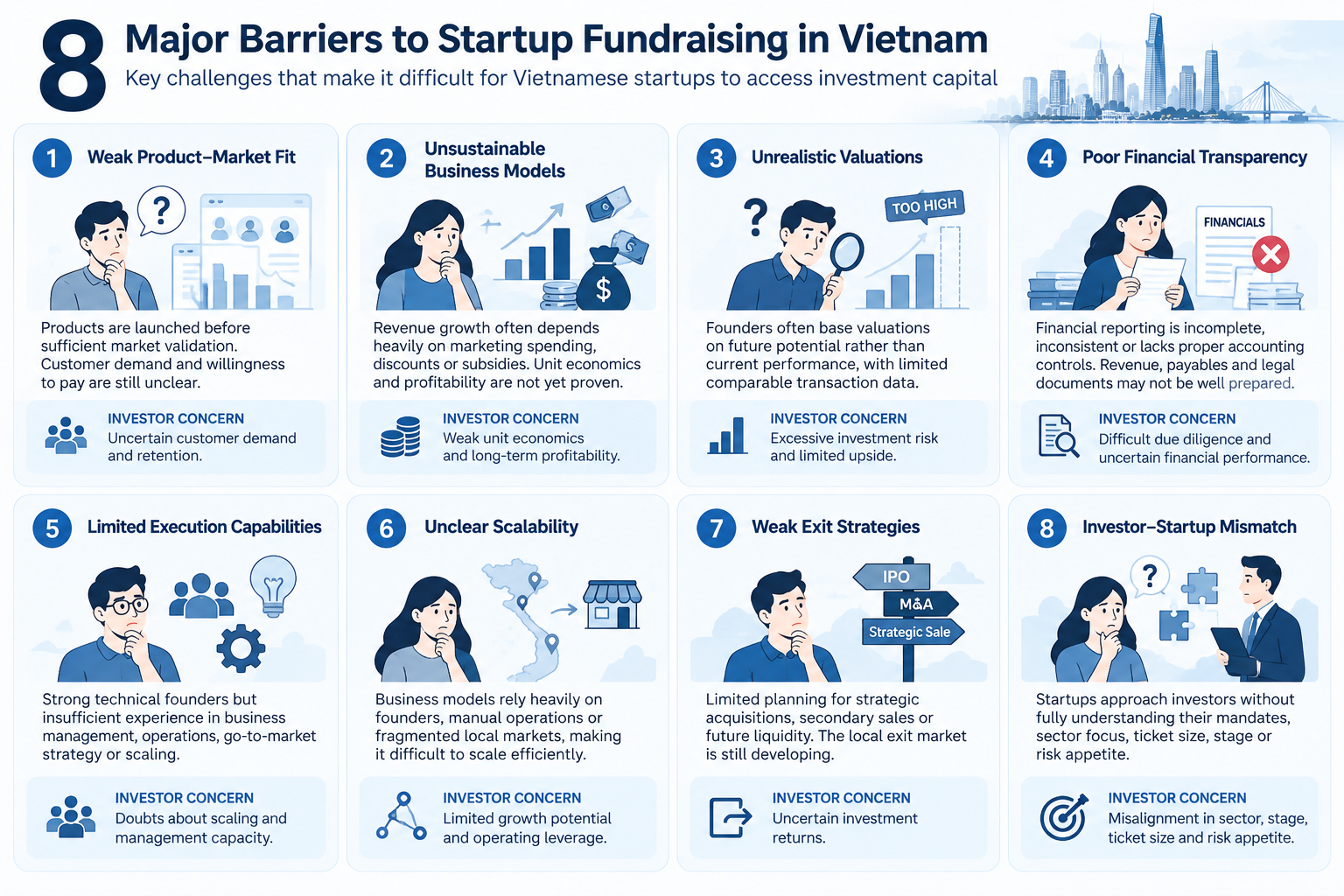
1. Eight major barriers to startup fundraising in Vietnam
2. Structural challenges in Vietnam's investment ecosystem
Beyond company-specific weaknesses, several ecosystem-level factors make fundraising more complicated.
2.1 Limited availability of appropriate risk capital
Different startup stages require different types of financing.
Early-stage companies may be too risky for banks, too small for private equity, and insufficiently validated for institutional venture capital.
This creates a financing gap between initial product development and the point at which a business becomes commercially attractive to professional investors.
2.2 Legal and regulatory complexity
Vietnamese startups may encounter challenges involving foreign ownership, investment approvals, intellectual property, shareholder agreements, and cross-border holding structures.
Foreign investors may require additional legal due diligence or restructuring before investing, increasing transaction costs and extending fundraising timelines.
2.3 Limited exit visibility
Venture capital depends not only on company growth but also on the ability to realize investment returns.
Vietnam's startup ecosystem has fewer established, repeatable exit pathways than more mature venture markets. Potential buyers exist, but acquisition readiness, valuation alignment, and transaction execution can be difficult.
2.4 Information asymmetry
Founders often understand their businesses deeply but struggle to communicate their investment cases in a structured, evidence-based format.
Investors, meanwhile, may lack reliable access to standardized financial, operational, and market information about private companies.
This information gap increases due diligence costs and reduces investor confidence.
3. How Vietnamese startups can improve investment readiness
I recommend a structured approach built around four stages.
Stage 1 — Business & Investment Readiness Assessment
Evaluate product–market fit, financial performance, management capabilities, legal compliance, scalability, and investment risks.
Output: Investment readiness scorecard and gap analysis.
Stage 2 — Investment Case Development
Build realistic financial projections, valuation scenarios, growth strategies, funding requirements, and capital allocation plans.
Output: Financial model, valuation analysis, and investment thesis.
Stage 3 — Investor Documentation & Due Diligence Preparation
Prepare a pitch deck, investment memorandum, cap table, legal documentation, and structured data room.
Output: Investor-ready fundraising package.
Stage 4 — Investor Matching & Transaction Execution
Identify suitable investors, structure the transaction, negotiate terms, coordinate due diligence, and support closing.
Output: Targeted fundraising process and transaction execution plan.
Conclusion
Vietnam's startup fundraising challenges reflect a combination of company-level weaknesses and broader capital-market limitations.
Although funding conditions and investor appetite will fluctuate, several fundamentals remain essential: strong execution, sustainable economics, transparent governance, credible valuation, and clear investment returns.
The next generation of successful Vietnamese startups will not necessarily be those with the most innovative ideas, but those capable of transforming innovation into scalable, financially sustainable, and investment-ready businesses.
Investment readiness is no longer just a fundraising requirement. It is becoming a strategic capability for long-term business growth.